 Courtesy of Entière DermatologySave this storySave this story
My jaw ate my chin.
At least, that’s what it looked like to me. Every time I looked in the mirror from the side, all I could see was the general lack of structure along my jawline to my chin. “You have a mildly recessed chin,” says Melissa Kanchanapoomi Levin, MD, a board-certified dermatologist in New York City. I’ve been a patient of Dr. Levin’s for roughly eight years. She knows my face up close and personal and can attest to the fact that my jaw did not, in fact, eat my chin. Still, my lack of chin had made me feel self-conscious for a long time.
There’s nothing “wrong” with my chin. It’s a chin! It does its chin job. But I wanted more balanced facial features without undergoing a permanent procedure, such as an implant. I wasn’t looking to dramatically change my chin, but over the years, Dr. Levin and I had talked about the option of filler to give it more structure, and the idea stuck with me.
In this story:
- What is chin filler?
- Making the decision to get chin filler
- Prepping for filler
- The injection process
- Post-injection guidelines
- Overall thoughts
What is chin filler?
“Filler generally refers to any substance that can help lift or angle tissue; it’s most commonly composed of hyaluronic acid,” says Dhaval G. Bhanusali, MD, a board-certified dermatologist in New York City. “Fillers tend to be good options for those who have volume deficits.” With chin filler, specifically, “we look to see if there is an imbalance, with chin protrusion appearing disproportionate with the rest of the face,” he explains. Colloquially speaking, you might call this a “weak chin.”
Determining what type of filler a “weak chin” would need is a little more nuanced because not all fillers are created equal. What works for the lips or other parts of the face may not work for the chin and vice versa. That's why dermal fillers are categorized by their stiffness, a.k.a. their G-prime level. “When we are looking at the chin, generally, we use a pretty firm, high G-prime filler, and that's because it helps mimic the bone,” Dr. Levin explains. “Something that's going to give a lift.”
There are a number of high G-prime filler options on the market—Allergan's Juvéderm Volux and Juvéderm Voluma XC (both are best used for structuring the chin and jawline), Merz Aesthetics' Radiesse (best for smoothing deep wrinkles and adding volume to the lower face), and Galderma's Restylane Lyft (best for adding volume to the cheeks and midface)—but deciding what is right for your face is a decision between the provider and patient. For my face, Dr. Levin determined Volux would be best. (More on that later.)
Making the decision to get chin filler
Rewind to two years ago, during an ordinary neurotoxin appointment, when, on a whim, I asked Dr. Levin for filler. She obliged.
As scary as this may sound, “on a whim” is typically how I describe my decision-making process, especially when it comes to in-office procedures. This has also applied to neurotoxin treatments, radio-frequency microneedling, and lasers. As a beauty editor, I’m a little less fearful of treatments because of the reporting and extensive research I’ve done over the span of my career. Still, I have to admit, suddenly deciding to get facial filler after years of insecurity felt a bit radical.
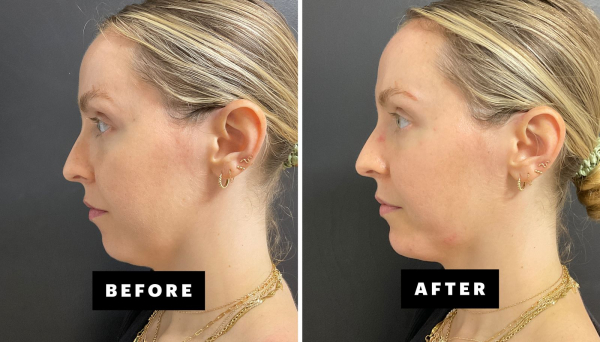
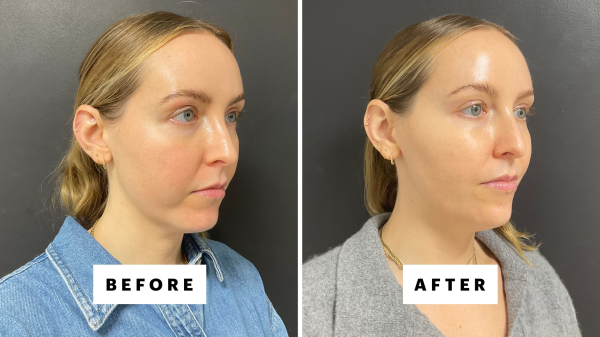
Beauty director Sarah Kinonen before and then immediately after filler and neurotoxin injections in 2024.
Courtesy of Dr. Melissa Kanchanapoomi Levin
But as I said, Dr. Levin knows me and my face very well, and from her perspective, this decision, although it was unexpected, made sense anatomically. And because I was an ideal candidate for filler, she immediately approved.
“You have great skin: thick, healthy, robust skin,” she says. “You don't have any underlying skin laxity. You really fit the profile of what makes for a good candidate.” That’s also because I was 33 at the time. People in their early 20s are less likely to be appropriate candidates for filler because facial features change as we age. (As we get older, volume and bone loss occur, as well as general sagging.) Plus, I don’t smoke, and I do have realistic expectations when it comes to results.
“Patients should have an understanding of what fillers can and cannot achieve,” says Dr. Levin. “They can enhance, but they don't offer the same type of dramatic results that surgical interventions can. The role of filler is more subtle, natural-looking improvements rather than dramatic changes, [though] they may feel dramatic to you.”
Prepping for filler
After it was decided I would get filler right then and there during my 2024 appointment, Dr. Levin and her team started to prep. This included cleaning the injection sites (chin and jawline), slathering on a hefty amount of numbing cream, walking me through the procedure, and, most importantly, ensuring I knew the possible side effects of facial filler.
Common side effects include bruising, swelling, and potential allergic reactions. “With any cosmetic procedure, there are always risks,” says Dr. Bhanusali. “Even in the most experienced hands, there is always a risk of occlusion (injecting filler into a vessel), which can lead to compromised tissue, blindness, and other issues.” That’s why it’s important to always see a board-certified dermatologist or plastic surgeon for these types of in-office procedures.
Dr. Levin also needed to confirm that I didn’t have any alcohol in my system (no problem—I don’t drink); hadn’t gotten a dental procedure in the last two weeks or have one scheduled (this can weaken the immune system); and that I hadn’t taken aspirin or ibuprofen within the last day or two (this can cause bruising).
The injection process
As I was waiting for the numbing cream to kick in (I couldn't feel anything from the bottom lip down), Dr. Levin decided which filler I’d be getting. Here’s the thing about filler: It’s not a one-size-fits-all treatment. There are many (and I mean many) different types of injectable hyaluronic acid on the market, and the kind I got during my procedure was right for my face and body. It’s important to note that what is right for me may not be right for everyone; that decision should be made by the patient and dermatologist together.
There are different types of filler available for use on the chin, says Dr. Levin, but for my 2024 appointment, she chose Juvéderm’s Volux, which is FDA-approved for jawline enhancement. “Volux is a filler that we use more for structural enhancement,” she says. “We inject it onto the bone to help with that anatomical recession of your chin.” Volux made the most sense in my case because she would be building out my chin and jawline—and this filler is FDA-approved to do just that.
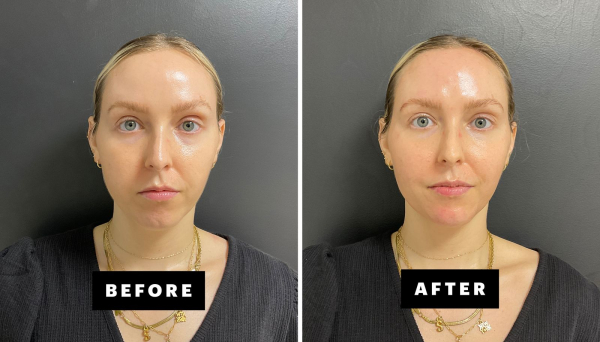
Kinonen before and then immediately after filler and neurotoxin injections in 2024.
Courtesy of Dr. Melissa Kanchanapoomi Levin
Because you can’t just inject one area of the face to create anatomical symmetry, especially in my case, Dr. Levin also used another filler, Juvéderm Vollure, to give me “some periorial support” in the area right above my chin but below my lips. With Vollure, she used a cannula, a blunt-ended tube, to do the injection. This was “to minimize the risk of [the filler] moving [around after it is injected/while it is injected], but also to help minimize the risk of filler getting into arteries and veins,” Dr. Levin explains, “so we can be a bit more safe in an area that has more arteries and more vessels.”
She adds, “There is no perfect way to inject. There's no recipe that says, ‘This is exactly how you do it.’ It's more like cooking intuitively.”
And to cook up my results, Dr. Levin used “two syringes of Volux and half a syringe of Vollure” on my chin and jawline. I should note that the cost of filler varies and typically depends on what type is used, how many syringes are needed, where in the country you’re getting treatment, and who is doing the injecting. In my case, the procedure would likely range from $800 to a few thousand dollars, but because I would be writing about my experience, the treatment was performed gratis.
After the filler was injected, Dr. Levin sculpted it into place. Imagine crafting a figurine out of clay—she was literally molding the hyaluronic acid injected under my skin into a shape and position that best suited my facial anatomy. This was the most interesting and hands-on aspect of the entire procedure to me, but it’s not always necessary, according to Dr. Levin.
Once injected, she sculpted the filler into place, literally molding the hyaluronic acid that was under my skin, like crafting a figurine out of clay.
“There are certain places where sculpting helps with achieving the desired outcome when we're using fillers. Every face is unique, and fillers are obviously placed strategically and sculpted to complement the patient's natural contour,” she points out. “For me, sculpting helps fine-tune the placement, and it also ensures that the filler integrates well with the surrounding tissue to enhance the facial structure. I will sculpt typically on the chin, maybe a little bit on the jawline, for a sharper angle or a softer transition, depending on what I'm trying to achieve.”
This may sound painful, but because I was numb from the bottom lip down, all I felt was pressure. The actual injections didn’t hurt, and the pottery work didn’t either. What did hurt, though, was my chin, about an hour post-procedure—but more on that in a minute.
Post-injection guidelines
As someone who had never gotten any kind of facial filler before, I wasn’t sure what to expect post-injection. And when Dr. Levin said, “We don't want you to eat a ton of salty foods because it can increase the risk of swelling,” I audibly gulped. I certainly wasn’t expecting that directive, and it couldn’t have come at a more inopportune time: The next morning, I would be hopping in a rental car for a six-hour road trip during which fast food would be the only thing on the menu. Spoiler: I did end up eating McDonald’s hashbrowns despite my doctor’s advice. (I’m sorry, Dr. Levin, I couldn’t resist!)
Diet aside, I was also told to take it easy on the workouts for the next couple of days. Again, this wasn’t ideal: I was in the midst of training for a marathon! Dr. Levin did mention that a jog here and there wouldn't hurt—“It’s not going to mess up or move the filler,” she explained, but I wasn’t about to chance losing my fancy new chin just to log a few lakeside miles.
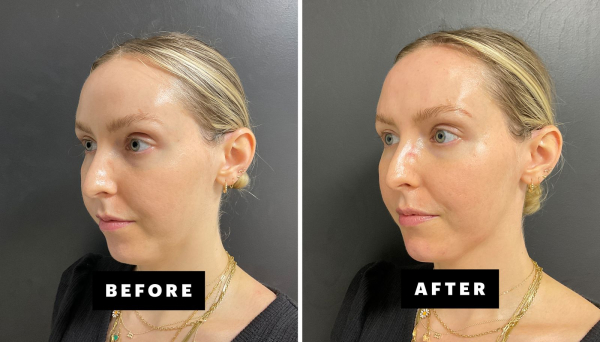
Kinonen immediately before and immediately after filler and neurotoxin injections in 2024.
Courtesy of Dr. Melissa Kanchanapoomi Levin
Plus, my face (well, the lower half) was really tender. Dr. Levin said it would feel like “someone punched me in the chin,” and she wasn’t wrong. It also felt like my face had just been injected with a foreign object….Hmm, weird. I tried my best not to touch the area (or let my dog accidentally touch it—she’s a jumper) and slept on my back for the next two weeks. (The joke’s on me because, apparently, my preferred side-sleeping position would have been just fine after the first 24 hours.)
“Sleeping on your face is fine,” Dr. Levin reassured me when I went back for my two-week checkup. “But filler migration is 100% real. For a long time, the aesthetic industry treated migration like a myth or a rare complication. That's not true. We have ultrasound MRIs of the face that have conclusively proven that dermal fillers can, and they do, move away from your original injection site." Migration can occur for a number of reasons, such as overfilling, using the wrong type of filler, or being treated by an unskilled injector (which is why it's so important to see a board-certified dermatologist or plastic surgeon).
When this happens, there is a fix. “The good thing is that migrated filler is made up of hyaluronic acid,” Dr. Levin says. "If we see filler migration, we use hyaluronidase, which is an enzyme that basically dissolves the product.” Luckily, I didn't have movement after either of my appointments, but it is still a real fear of mine, hence the sleeping on my back.
Bruising and swelling typically go down after five to seven days, and that was definitely true for me. It took a full week for the faded bruising to clear, but during that time, no one seemed to notice my blue and purple spots and lack of concealer to cover it up. As I said, I didn’t want to touch the area, so I went sans makeup for as long as I could during the healing process.
Overall thoughts
Two weeks after my first appointment
After my initial two-week checkup, when Dr. Levin inspected her work (and complimented me to no end), I couldn’t be happier with the results. The outcome is subtle but noticeably beneficial to my overall facial balance, at least as I see it. “You have incredibly beautiful bone structure in your mid-face,” says Dr. Levin. “You have a beautiful jawline. Your enhancement is actually quite mild.”
Mild or not, the procedure has changed my life (not to sound dramatic). It changed my outlook on filler as a whole and gave me a big ol' boost of confidence. I have a chin! I have a jawline! And I can see both in photos—from every angle!—for the first time. It’s a beautiful feeling.
Even more beautiful? The fact that I don’t need to get a re-up every few months. “Filler can last between 8 and 12 months, and sometimes longer, depending on the patient,” says Dr. Bhanusali. “So start slow and remember, you can always add more; it’s a marathon, not a sprint.” As someone who has run a marathon, I get it.
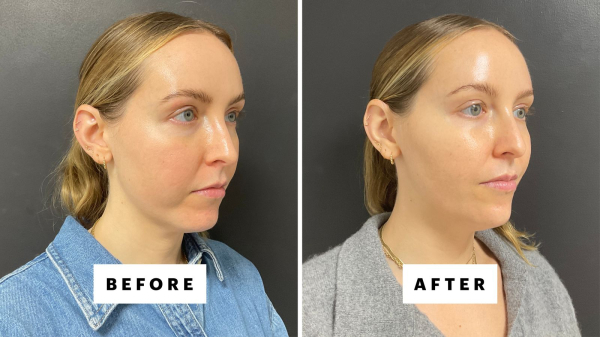
Kinonen before and then two weeks after filler and neurotoxin injections in 2026.
Courtesy of Entière DermatologyTwo years after my first appointment
It's now been two years since my first marathon and initial filler appointment, and while I've halted my racing career, my filler journey is just getting started. The filler has been slowly dissolving over the last 24 months, so I was due for a refill.
For my first appointment, Dr. Levin used almost two syringes of Volux, but for my second round this year, she pivoted to Voluma, a high-G-prime filler, and used only one syringe. “You still had a bit of support there, so I felt like we didn't need to use something so hardy,” she explains. “This year, I actually did even more jawline support (last time, we did it at the angle of the jaw all the way, like in front of your ear), but this time, I did the entire angle of the jawline. We actually filled the dips behind the jowl—we call it a post-jowl sulcus, so that you can straighten a wavy jawline.”
She did this with the use of a cannula, which I'm not a big fan of. Sure, it doesn't pinch like a needle would, but it does feel…weird. Imagine a long, thin tube under your skin, pumping in filler—it's an odd sensation (more pressure, less pain) that doesn't bring me much joy. “We made a little entry site behind your jowl, so that we can thread the filler in the subcutaneous plane," she says. “It's like a smooth ribbon of filler.”
And just like my first filler experience, Dr. Levin also built up the area around my mouth (filling in my marionette lines) with Juvéderm Vollure to give a bit more support to my chin. “It's a lot softer and is very flexible, so I like it for areas that need a lot of mobility,” she says, adding that Vollure can last up to 18 months.

Kinonen, two weeks after her filler appointment in early 2026.
Courtesy of subject
The results—a chin that falls directly under my mouth (as opposed to its previously receding position) and a sharper jawline with structure—speak for themselves. I have a chin and a jawline. And both are (temporarily) anatomically pronounced. Because of that last bit, I've been asking myself, Is this something I want to continue to do for the rest of my life? And dermatologically speaking, can I?
“Yes, long story short, you can definitely continue getting dermal fillers, but is it going to be exactly the same every time? No,” says Dr. Levin. “The aging needs of when you're 60 are going to be really different when you're 35.” She says doing the same thing for every appointment can eventually look overfilled or distorted. “Sometimes you can't just keep on mimicking and giving high G-prime filler in the same way,” she adds.
For now, though, I'm only 35, and I've got a few more decent filler appointments up my sleeve. Based on the results of my first two sessions, I will absolutely continue down the filler road. So, see you back here in two years for my next update?